How Atlantic Canada's aging population is changing how we think about homes
- Judith Mendiolea Lelo de Larrea
- Apr 20
- 9 min read

Accessibility renovations, adaptations and purposeful construction are factors that need to be considered as our population ages
Originally published by The Telegram Mar 12, 2026

Carolyn Villard looks at her home a little differently these days.
It’s the place where her routines live, familiar rooms, the neighbourhood she knows, the people around her.
But as she gets older, the P.E.I. senior has begun to think about something that many Canadians avoid discussing until it’s too late: what it will take to stay there.
“I’m a senior, and I would really want to live in my home as long as I can,” she said.
Having worked for years in the health system and in care facilities, for Villard, the idea of leaving that home is both a practical concern and deeply personal. She is the co-chairperson of the non-profit Age Friendly PEI, where they advocate for the inclusion and participation of people of all ages and abilities in a community.
Her sisters, also in their 80s, have already started doing house modifications.
“Long-term care should be the last resort, the very last resort,” she said.

Housing design and community
An age-friendly community goes far beyond housing design.
It includes reliable transportation, access to health care and home support services, walkable streets, nearby grocery stores and pharmacies, and opportunities for social connection. The concept, promoted internationally by the World Health Organization, focuses on adapting entire communities so older adults can remain active, independent and connected as their needs change.
Across Atlantic Canada, that feeling is increasingly common.
The region has the oldest population in the country. According to the Canada–Nova Scotia Aging with Dignity Funding Agreement released in 2023, Atlantic Canada has the highest proportion of older adults in Canada. In Nova Scotia alone, about 21.8 per cent of residents are 65 or older.
Demographic projections suggest the shift is only accelerating. By 2041, people aged 65 to 84 could represent roughly a quarter of the population in Atlantic provinces, increasing pressure on housing systems. Already, about nine per cent of Canadians over 65 live in what Statistics Canada defines as “core housing need,” meaning their homes are overcrowded, in poor condition or unaffordable.
But another challenge often goes unnoticed: many houses themselves were never designed for aging.
For many seniors, the question isn’t simply where they want to live in the future. It’s whether their homes will allow them to.
“It’s quite traumatic if you were a citizen out there and you have to move to community care or you have to move to long-term care, because you’re leaving all your supports and your familiar places,” Villard said.
The desire to stay home
Like Villard, many older adults say they want to remain in their homes as long as possible, a concept often called aging in place.
But doing so safely can require planning that many homeowners never considered when their houses were built.
Carrie Greene knows that both professionally and personally.
Greene, a Fredericton-based designer certified as an Adaptive Home Specialist, has spent years studying how homes can be adapted to meet people’s needs as they age. The topic became even more personal for her in recent years.
“In 2016, I was officially diagnosed with MS,” she said. “While I don’t really have any physical disabilities with it at this point, I know that it’s something that could be down the road for me.”
That possibility has changed the way she thinks about the homes people live in and the small design choices that can make a big difference later.
“Being able to use the washroom and bathe yourself is probably the most important thing in preserving somebody’s dignity as they age,” Greene said.

The hidden risks inside the house
When Greene talks to homeowners about aging in place, she often starts with the same room: the bathroom.
“The bathroom, of course, is the most dangerous room in the house for anybody,” she said.
Many older homes contain barriers that people rarely notice until mobility becomes more difficult. Narrow doorways, steep steps, dim lighting and bathrooms without support bars can turn everyday routines into risks. Hallways may be too tight for mobility aids, while door handles and switches are often placed without accessibility in mind.
These architectural details are among the most common reasons seniors eventually relocate to assisted or institutional care.
But many improvements, Greene said, are simple and far easier if they’re planned ahead of time.
“If you’re going to renovate your bathroom, you can think ahead and add blocking behind the walls so that you can add grab bars later,” Greene said. “Within the bathroom, obviously grab bars would be number one, and probably one of the easiest things to do.”
The key, Greene said, is thinking about those changes before a crisis forces them.
“If you have the ability to think of these things ahead of time and do it when you’re already renovating, it’s significantly less expensive than trying to add them later.”
That approach is becoming more common as Canada experiences a surge in home renovations. According to Altus Group, a provider of commercial real estate and construction intelligence, 56 per cent of residential investment in Canada in 2024 went toward renovations, compared with 44 per cent for new housing construction. The trend reflected an aging housing stock and a growing number of homeowners choosing to adapt existing homes rather than move.

Breaking the cost myth
One of the biggest barriers to planning ahead is the assumption that accessibility upgrades are expensive or unattractive.
Greene hears it often.
“One of the myths that surrounds renovating for aging in place is the price. It doesn’t have to be expensive,” she said.
Some of the most effective changes are relatively simple: wider layouts, accessible bathrooms and preparing walls so safety features can be installed later if needed.
Planning ahead can also extend beyond the house itself.
“When you’re investing in a home, it’s important to think about things like transportation and health care nearby,” Greene said.
Those considerations highlight a reality many homeowners don’t realize until much later: a house alone doesn’t determine whether someone can remain there.
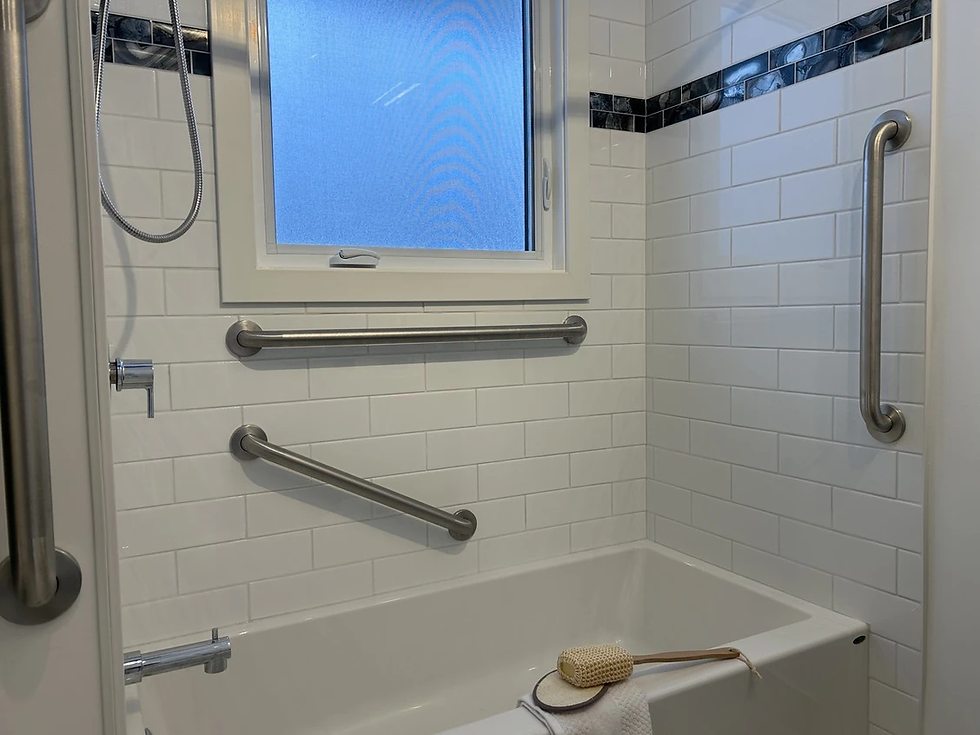
A bathroom renovated for accessibility by designer Carrie Greene includes features such as grab bars and a layout designed to support mobility and safety. Contributed
More than just the house
Judy Lane has spent decades thinking about that broader picture. She worked as a nurse for 35 years and managed nursing homes before deciding to approach the issue from a different angle.
“Once I learned the system and how people are housed in institutions, I really said to myself, ‘there’s going to be a better way,’” she said. “I don’t want to help people move into nursing homes. I want to help them stay out of nursing homes.”
She is now the CEO of the social enterprise HomeCare by Design, a home care agency she started, aiming to provide housing and support services that could work together to help seniors remain independent.
Because even the most accessible home has limits, she points out.
“You can’t age in place without the support of your family, friends, or professionals,” Lane said.
Transportation, help with errands, access to medical appointments and social connection can all determine whether someone is able to stay in their home long term.
Yet those supports are often missing from the way housing is planned.
“Developers build a building, and that’s where they stop. None of the other supports are there to help people,” Lane said.
Rural challenges
In Atlantic Canada, geography can make those gaps even wider.
Many seniors live in rural communities where services are limited and transportation options are scarce. Access to home care providers can be inconsistent, and public transit is often unavailable outside larger towns.
“You can renovate your home as nice as you want, but without support services, you’re eventually going to have to move,” Lane said.
The reality leaves many older adults facing difficult decisions, whether to remain in their communities without adequate support or move somewhere that offers services but feels unfamiliar.
A different approach
Lane is now working on a project she hopes will offer another option. She is developing a community designed specifically to help people age in place, a mix of garden homes and condominiums built with accessibility in mind and supported by nearby services.
The project will include 60 units, designed with features such as barrier-free bathrooms, open layouts and entrances without steps. The idea is to create homes where people can continue living independently even as their needs change.
“The floor plan is all accessible. There’s zero-threshold entry everywhere going into the garage, front door, back door,” Lane said. “There are no sidewalks because I have found over the years that people in walkers and wheelchairs sometimes trip over.”
But this is an insight only builders with experience can get.
“And if you don’t see these things over the years, if you don’t work with seniors and understand what they need to get around, then you don’t always think of all those things,” she said.
Why change is slow
Despite growing awareness, accessible housing remains far from the norm.
Part of the reason, Lane said, is economics.
“Developers are looking for the most economical way to build, so they don’t always put these extras in,” she said.
Across Atlantic Canada, building codes generally ensure accessibility in public spaces and certain new developments, but most single-family homes are not required to follow universal design standards.
Another barrier is psychological.
“People don’t want to talk about it. They don’t want to think about it, so they don’t do anything about it until it’s too late,” Greene said.
Lane encourages homeowners to look beyond renovations alone.
“Make sure you gather all your information first before you make a big investment in your home,” she said.
There are some programs designed to help seniors make those changes.
In N.S., the Seniors Care Grant helps cover services such as yard work, minor home repairs and transportation, with more than 40,000 grants approved in the 2022–2023 fiscal year, the latest data available.
Housing Nova Scotia also offers forgivable loans for accessibility upgrades, such as ramps or adapted bathrooms.
N.B. provides a refundable tax credit for residents aged 65 and older who complete accessibility renovations, allowing them to claim up to $10,000 in eligible improvements.
P.E.I. offers several programs, including the Home Renovation Program, which can fund major repairs up to $12,000 or $16,000 for accessibility upgrades related to permanent disabilities. The Seniors Home Repair Program provides up to $4,000 for smaller fixes, while the Seniors Safe @ Home Program offers up to $10,000 for accessibility modifications such as ramps, handrails or adapted bathrooms.
In N.L., the Home Modification Program supports accessibility upgrades for homeowners with low to moderate incomes, while the Provincial Home Repair Program helps fund essential safety repairs.
However, some of these programs are only available to lower-income households or depend on factors such as property value, income level or citizenship status.
Training programs are also emerging to help construction professionals better understand accessibility design.
The Canadian Home Builders’ Association offers an Adaptiv Home Renovation Course that teaches builders how to design homes suitable for aging in place. Both Greene and Lane have taken the course.
More recently, the Rick Hansen Foundation Accessibility Certification program has been introduced through the Nova Scotia Community College, offering training in universal design principles and accessibility assessment.
Still, at present, there are no professionals listed on the Adaptiv certification directory in Prince Edward Island.
A community conversation
For Villard, the conversation about aging in place goes beyond individual homes.
“There’s also a gap, I think, in understanding of what is actually needed in a house to make it accessible,” she said. “There needs to be a focus on providing housing… that is designed to keep people in place for as long as possible, physically keep people in place.”
Addressing that gap will require more than renovations or new developments, she believes.
“It’s everybody’s business… the whole community needs to support people to stay in place.”
That support can take many forms, accessible housing, better planning, stronger community connections.
But at its heart, the goal remains simple: allowing people to remain where their lives have unfolded.
For Villard, the hope is that the homes people build today, and the communities around them, will make that possible for years to come.


Comments